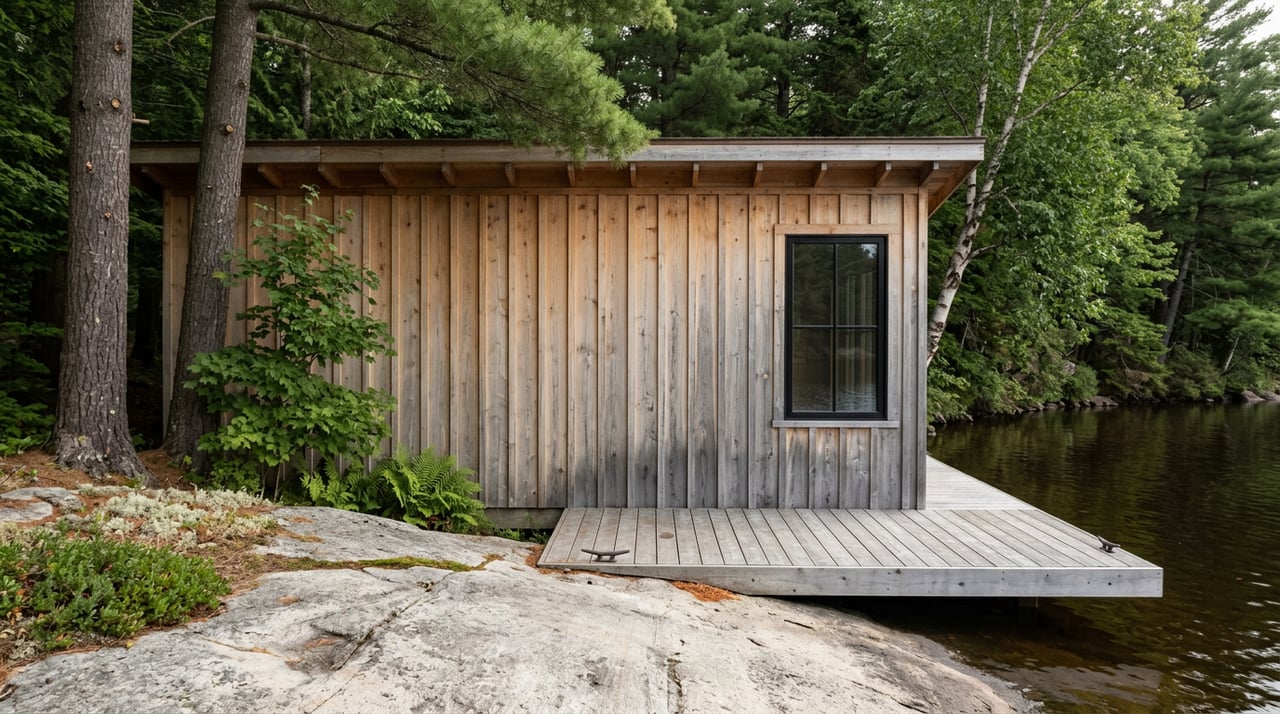
Every waterfront buyer in Kawartha Lakes eventually says some version of the same sentence: "the dock's been there since the seventies, so it's grandfathered." It is a reasonable thing to believe. It is also, for a large share of shoreline on the Trent-Severn Waterway, flatly untrue, and the gap between that belief and the actual rule is exactly where closings stall.
Parks Canada answers this question directly on its own realty site, in language plain enough that there is no room to argue with it later: no in-water structure is grandfathered or exempt from its Policies for In-Water and Shoreline Works and Related Activities, period. That includes docks, boathouses, marine railways, and shoreline stabilization built decades before the current rules existed. If a structure needs repair, replacement, or relocation, the age of the original build buys it nothing. A fresh application goes in as if the structure were being proposed for the first time.
The Water Is Federal. The Zoning Is Local. Neither Office Assumes the Other Handled It.
The reason this catches people off guard is that a Kawartha Lakes waterfront property usually sits under more than one layer of authority at once
Parks Canada owns and administers the bed of the Trent-Severn Waterway, meaning the lakebed itself under your dock, out to the original upper controlled water elevation. Anything built on, over, or under that bed, new or existing, requires a Parks Canada permit. Buying the house on top does not transfer an automatic right to keep, repair, or replace whatever is sitting in the water in front of it.
Layered on top of that is your local Conservation Authority. Kawartha Conservation regulates shoreline and in-water work within its watershed separately from the federal permit, and it runs on its own clock: minor standard permit applications are reviewed within 14 days, and once an application is deemed complete, the permit is issued within 21 days. Major applications get a 21-day review window of their own. That is a real timeline a seller needs to plan around if a structure needs sign-off before a sale closes.
Then there is the municipality. The City of Kawartha Lakes still governs zoning and building permits for the structure itself, and this is not a formality the federal or conservation layers absorb. In 2015, the Ontario Superior Court of Justice settled a dispute over exactly this question when the Township of North Kawartha argued its zoning bylaws did not reach structures built over Crown-owned lakebed. The court disagreed, ruling that a municipality cannot abdicate its zoning and Building Code Act authority simply because the land underneath is Crown land. In practice, that means your municipality's dock and boathouse bylaws still apply even on a shoreline where Parks Canada also holds jurisdiction. Nobody's approval substitutes for anybody else's.
Here is what that stack looks like in practice:
| Authority | What it actually regulates on your shoreline | Timeline or key detail |
|---|---|---|
| Parks Canada (Trent-Severn Waterway) | The lakebed itself, plus any dock, boathouse, crib, or shoreline stabilization touching the water | No structure is grandfathered; repair or replacement of an existing structure requires a new application |
| Kawartha Conservation | Shoreline and in-water work within the regulated watershed | Minor applications reviewed in 14 days, permit issued within 21 days once complete; major applications reviewed in 21 days |
| City of Kawartha Lakes | Zoning, building permits, and shoreline road allowance encroachments | Encroachment license requests go to a Land Management Team that meets six times a year |
| MNDMF (Crown-bed lakes outside TSW jurisdiction) | Docks and boathouses on Crown lakebeds not part of the Trent-Severn system | A separate process from TSW permitting, relevant on some non-Waterway lakes in the broader region |
A dock that looks identical from the water can be sitting under any combination of these four regimes depending on which lake it's on and whether that lake is part of the Waterway at all.
The Locks and Lakes That Make This a Local Question, Not a Theoretical One
This is not an abstract federal-versus-local puzzle. It is geography you can point to. Five Trent-Severn locks sit inside Kawartha Lakes, and each one anchors a different stretch of shoreline under this exact jurisdiction. Bobcaygeon's Lock 32 was the first lock ever constructed on the entire Waterway. A few kilometres away, Lindsay's Lock 33 is the only lock on the whole 386-kilometre system built with a three-gate configuration instead of the conventional two. Fenelon Falls' Lock 34 sits at the center of what locals call the Jewel of the Kawarthas. Rosedale's Lock 35 connects Balsam and Cameron Lakes, two of the specific lakes where Parks Canada has run recent dredging and shoreline stabilization projects for private landowners, alongside similar work on Buckhorn, Pigeon, Stoney, and Sparrow Lakes.
If your prospective purchase sits on Sturgeon, Pigeon, Cameron, Balsam, Buckhorn, or Sparrow, you are on Waterway-regulated water. The federal permit layer applies whether the listing mentions it or not.
There is a smaller, rarer version of this story worth knowing too. A limited number of cottage lots in the region are not owned outright at all. They sit on land licensed from Parks Canada rather than held in freehold title, and that license comes with its own restriction: permission for seasonal use only, defined as May through October, with winter access allowed strictly for insurance purposes rather than year-round living. If a listing describes the underlying land as leased or licensed rather than owned, that is a different conversation entirely, and it belongs in front of a real estate lawyer before an offer goes in.
What This Means If You're Buying
Before waiving a condition on a Kawartha Lakes waterfront property with a dock or boathouse, ask for the paperwork, not just the assurance:
- Copies of the existing Parks Canada in-water and shoreline works permit for every structure on the property, if the shoreline touches the Trent-Severn system
- Confirmation of whether the property has ever gone through a Kawartha Conservation review, and if so, the outcome
- A title search that specifically addresses the extent of private ownership relative to the Waterway bed, since Parks Canada's jurisdiction can extend further into the water than most buyers assume
- Whether the current structure has a notification page posted at the waterfront, which the Balsam Lake Association says permit holders are required to display and which lists the permit number directly
If any of that documentation doesn't exist, that is not automatically a dealbreaker. It is a known cost and known timeline you can build into your offer, rather than a surprise your lender's counsel raises the week before closing.
What This Means If You're Selling
The sellers who move fastest are the ones who assembled this file before the property ever hit the market. If you're planning to list a Trent-Severn waterfront property in Kawartha Lakes, pull together your Parks Canada permit history, any Kawartha Conservation correspondence, and your municipal building permit records now, while there's no closing date pressuring the request. A complete permit file removes the single most common reason a qualified buyer's lawyer asks for an extension.
A Few Direct Questions
Does this apply to my cottage if it isn't directly on the Trent-Severn Waterway? The federal permit layer applies specifically to lakes and rivers that are part of the Waterway system. A lake outside that system may still involve Crown lakebed rules through the Ministry of Northern Development, Mines, Natural Resources and Forestry, but it is a different process with different contacts.
Can I just replace my dock exactly as it is, since nothing is changing? No. Parks Canada's own guidance states that repair, replacement, relocation, and removal of existing structures all require a permit application, the same as new construction. There is no like-for-like exemption.
Is this the same issue as a shoreline road allowance problem? No. A shoreline road allowance is a separate, older question about land between a private lot and the water. The permitting question here is about the dock or boathouse itself and who has jurisdiction over the water it sits in. A single property can face both issues at once, but they are resolved through different offices.
A boathouse that's been part of the view for forty years still deserves the paperwork that says it's allowed to stay there. If you're weighing a purchase or preparing to list a Kawartha Lakes waterfront property and want a clear read on what's documented and what isn't before you're under contract, Lakelands Real Estate Co. works this shoreline regularly and can help you get ahead of it. Get your free home valuation and a straight answer on what the file actually shows.
This article is general information, not legal, tax or financial advice. Consult a qualified professional about your situation.