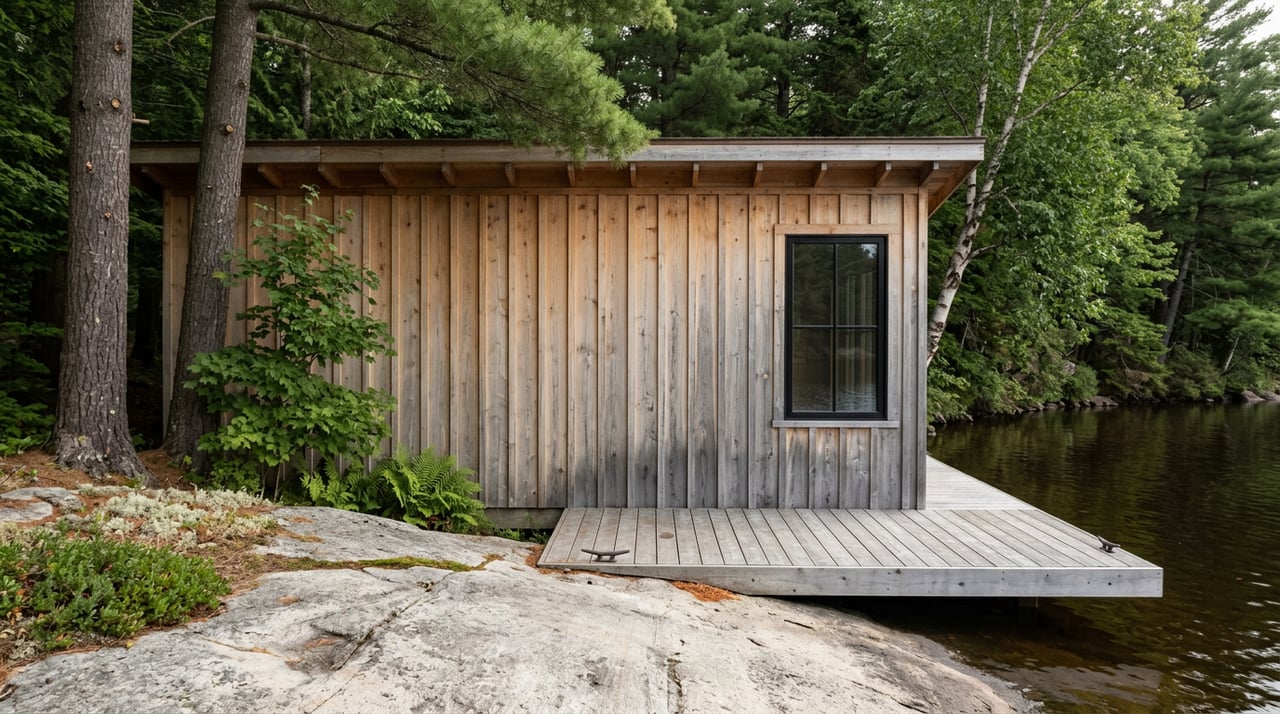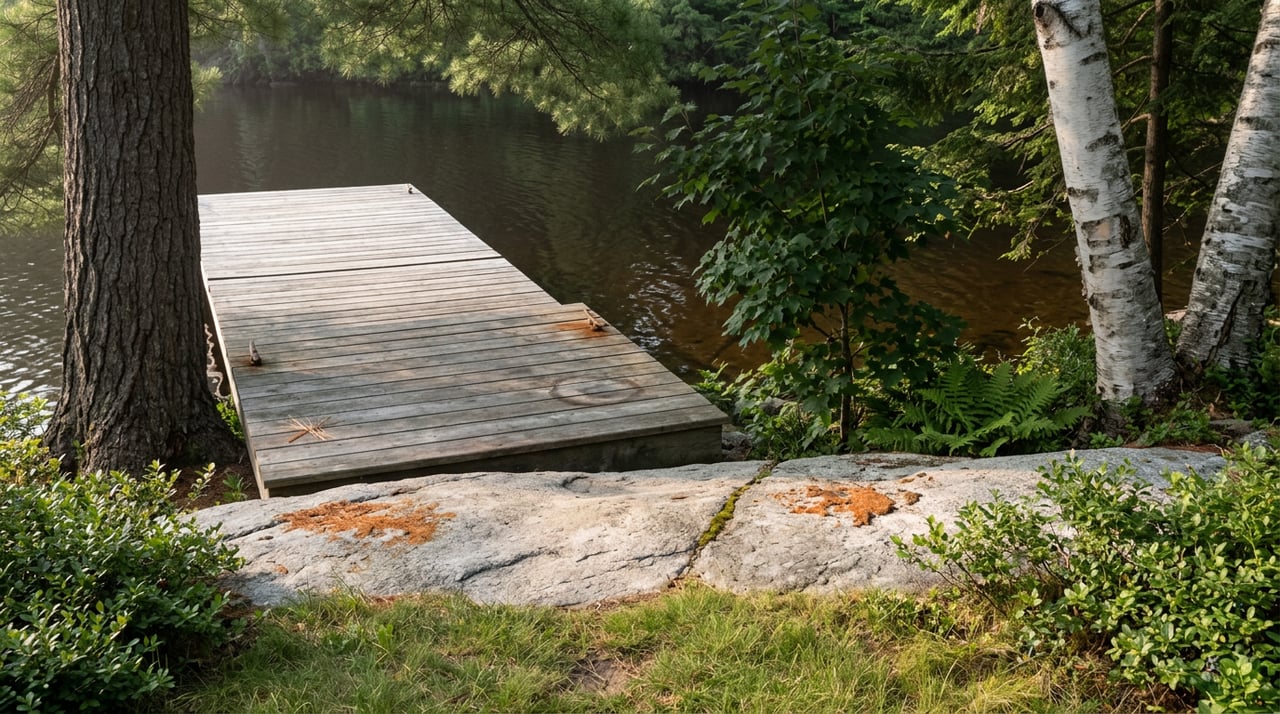
Every waterfront listing photo in Haliburton County tells the same story: dock reaching into the water, shoreline framed by pine and granite, the whole scene photographed as though it belongs to the buyer the moment the deal closes. Often, a strip of that land doesn't belong to anyone but the township.
That strip is called a shore road allowance, and according to one estimate a Haliburton-area realtor gave to Cottage Life, roughly eighty-five percent of properties in the county sit behind one. Most owners never think about it until a lender, a building inspector, or a short-term rental license application forces the question. In 2026, one Haliburton township started enforcing the rules around it for the first time, which means the strip that used to be a paperwork curiosity is now a real closing risk.
What a Shore Road Allowance Actually Is
When Crown surveyors mapped out the townships around Haliburton's lakes in the late 1800s, they set aside a band of land along the water, roughly 20 metres or 66 feet deep, originally meant to give loggers and transportation companies a route along the shore. Roads never got built on most of it. Instead the land sat there, technically owned by the municipality, while cottages, docks, and boathouses were built up to and sometimes onto it over the following century.
Some of that land has since been sold back to the abutting property owner and is now considered closed. A lot of it hasn't. As the Algonquin Highlands township page puts it plainly, most waterfront properties in the township still have that 20-metre strip separating them from the water, and unless it's been formally purchased, the municipality still owns it.
Where It Actually Surfaces in a Transaction
The allowance rarely shows up on a listing sheet. It shows up at three specific moments, and each one can stall a deal that was otherwise ready to close.
Financing. If a cottage, deck, or dock encroaches onto land the seller doesn't own, a lender may require the allowance be purchased before approving a mortgage. The law firm HGR Graham Partners LLP notes that determining whether a road allowance exists, and whether anything sits on it illegally, is something a lawyer typically confirms through a title search at the time of purchase, not something a buyer should assume is fine because the seller never mentioned it.
Lot coverage. Many townships cap how much of a lot can be built on, often twenty to thirty percent of total area. Purchasing the shore road allowance adds square footage to the property, which can be the difference between a modest addition and one that exceeds the coverage limit.
Short-term rental licensing. This is the sharpest edge. Haliburton County's short-term rental bylaw, developed after years of council debate, added a clause that prohibits licensing an STR if the building sits on a municipally owned shore road allowance. At a November 2023 county council meeting, planning director Steve Stone confirmed the county had built in a clause that would exclude any buildings located on municipally owned shoreline road allowances from operating as short-term rentals, a decision reported in detail by Cottage Life. Minden Hills mayor Bob Carter pushed back hard in that meeting, pointing out that his municipality alone processes eight to ten shoreline road allowance purchases at every council meeting and simply doesn't have the capacity to clear a sudden backlog if hundreds of existing rentals were caught by the rule at once.
Why 2026 Changes the Math
For most of the county, the shore road allowance question has been a slow-moving, mostly theoretical one. That changed in Algonquin Highlands. The township's License of Occupation policy, approved by council in late 2023, applies to structures sitting on a township-owned allowance, and unlike the same policy in neighboring municipalities it was written to apply retroactively, against the advice of the township's own planner. According to reporting compiled by community group HC Voices, that retroactive enforcement has been in effect since January 1, 2026.
Every other Haliburton-area municipality with a similar bylaw on the books, including Dysart et al, Highlands East, and Minden Hills, has chosen not to enforce it retroactively against existing structures. That leaves the county with a real patchwork rather than one uniform rule.
| Municipality | Shore road allowance posture as of 2026 |
|---|---|
| Algonquin Highlands | License of Occupation enforced retroactively on existing structures since January 1, 2026 |
| Dysart et al | Similar bylaw exists; not enforced retroactively to date |
| Highlands East | Similar bylaw exists; not enforced retroactively to date |
| Minden Hills | Similar bylaw exists; not enforced retroactively to date |
If a buyer is comparing two otherwise similar cottages, one on Maple Lake in Algonquin Highlands and one on a lake in Dysart et al, the shore road allowance question isn't background information anymore. It's a live compliance issue on one side of that comparison and a dormant one on the other.
Under the Algonquin Highlands policy, existing structures built before the bylaw are generally allowed to stay, but only stairs, docks, and pump houses can be replaced, and only with a building permit. Anything the township judges unsafe can be ordered repaired or removed at the owner's expense. That's a meaningfully different risk profile than simply owning the shoreline outright.
What Buying the Allowance Actually Costs and Takes
Purchasing a shore road allowance is a formal municipal process, not a form you drop off at the front counter. It typically requires a survey or sketch of the parcel, a completed application, a deposit toward legal and administrative costs, and a public notice period during which neighboring landowners and utilities like Bell Canada and Hydro One are given a chance to respond before council approves the closing. Ares Law, which practices in the Muskoka and Parry Sound region, tells clients to expect the process to take up to a year from application to conveyance.
Costs vary by municipality and are set by each township's own fee schedule. As one point of reference, the neighboring Muskoka town of Huntsville lists its 2026 fee schedule publicly: an application fee of $1,187, per-square-metre land costs ranging from $11 to $17 depending on the waterway, and a $2,650 legal fees recovery deposit, on top of survey costs the applicant arranges separately. Haliburton County's four municipalities each set their own numbers, so that Huntsville schedule should be read as an example of the shape of these costs rather than a Haliburton quote, but it gives a buyer a realistic sense of what to budget for before assuming a shore road allowance purchase is a minor administrative step.
What This Means If You're Buying or Selling Right Now
For a buyer, the practical move is to ask the question before writing an offer, not after a home inspection surfaces it. Confirm through a title search or a direct call to the municipality's planning department whether the property includes the shore road allowance or sits behind one, and if the dock, boathouse, or bunkie encroaches on it. If the property is in Algonquin Highlands, ask specifically whether a License of Occupation has been secured for any structure on the allowance, since that's now an active enforcement matter rather than a formality.
For a seller, the value of getting ahead of this is straightforward. A buyer's lawyer will find the allowance status during due diligence regardless. Disclosing it early, along with any application already in progress to purchase or license it, keeps the closing timeline from stretching unexpectedly in the final weeks of a deal.
For anyone weighing a Haliburton cottage as a rental income property, the shore road allowance question is no longer separable from the licensing question. A property currently operating as a short-term rental could lose its eligibility if it sits on an unpurchased allowance and hasn't secured the required agreement, regardless of how long it's been renting successfully.
A Few Direct Questions
Does every waterfront property in Haliburton County sit behind a shore road allowance? No. Newer lots created through recent severances are more likely to already include the allowance, since the process for closing and conveying it is often worked through as part of the severance application, as Dysart et al's planning department confirms it handles alongside its other land division work. Older, long-held cottage lots are the ones most likely to have an open, unpurchased allowance still sitting between the building and the water.
If my dock already sits on the allowance, can I keep using it? Generally yes for now, but the terms depend on the municipality. Under Algonquin Highlands' policy, pre-existing structures are allowed to remain, but stairs, docks, and pump houses can only be replaced with a new building permit, and the township can order repairs or removal of anything it deems unsafe.
Are there rules for what I can do to the shoreline itself, separate from the allowance question? Yes, and it's a separate layer of regulation. The County of Haliburton's Shoreline Preservation By-law applies to land within 20 metres of the high-water mark in Algonquin Highlands, Highlands East, and Minden Hills, and it requires a permit before significant grading or tree removal in that buffer, whether or not the shore road allowance itself has been purchased.
A shore road allowance rarely stops a Haliburton sale outright, but it can quietly add months to one if nobody asks the question early. If you're weighing a purchase, planning a sale, or trying to understand what a specific lake-country property will and won't let you do, Lakelands Real Estate Co. can walk the title, the township file, and the shoreline together before you're locked into a closing date. Get your free home valuation and a straight answer on what you'd actually own.